If your Mac suddenly refuses to boot up properly, you might need bootable macOS install USB to make repairs. But how do you create such a disk if all you're left with is a Windows 10 computer? Fortunately, there's a great tool that you can use for free to create bootable macOS media on a USB drive in a Windows 10 environment. This article shows you how to download a macOS DMG file, format a USB drive using a GUID Partition Table, burn the DMG to the drive and boot your Mac from the USB. All the steps except the last one are done on a Windows 10 machine.
Sep 03, 2015 Here it is easy and quick to Download Mac OS X 10.11 Yosemite.DMG installer - Download Yosemite.ISO - Yosemite Torrent download - Without Apple Store ID. Download Official Yosemite installer.APP,.DMG,.ISO – OS X 10.10 – without Apple store. Create OS X Yosemite USB installer via DiskMaker X. Jan 28, 2020 How to create a bootable installer for macOS. It installs an app named Install OS X El Capitan into your Applications folder. Use the 'createinstallmedia' command in Terminal. Connect the USB flash drive or other volume that you're using for the bootable installer.
Part 1: Download macOS or Mac OS X DMG File
The first step is to get the DMG disk image file for the version of macOS that you want. You can get a copy of the latest macOS version from Apple download portal or App Store here. There are also several other direct download sites that offer various versions of Mac OS X in DMG format rather than the standard APP format that runs on Mac. Since you're working in a Windows environment, you need the DMG rather than the APP file.
Part 2: Format USB Drive to GPT
Mostly, the USB drive was formmated to FAT32 in default when being shipped out from the factory. However, FAT32 can be only used for installing OS with legacy BISO, which doesn't work for macOS. So the next step is to format your USB drive in the GPT partition style in order to burn installation files to the desired USB drive. You can do this in Command Prompt as admin. In elevated Command Prompt (Ctrl+Shift+Enter), input the following series of commands followed by Enter after each line:
Diskpart
List disk
Select Disk X (X stands for the USB drive name that appears after the previous command)
Clean
Convert GPT
Create partition primary
Part 3: Create Bootable macOS USB from Windows 10
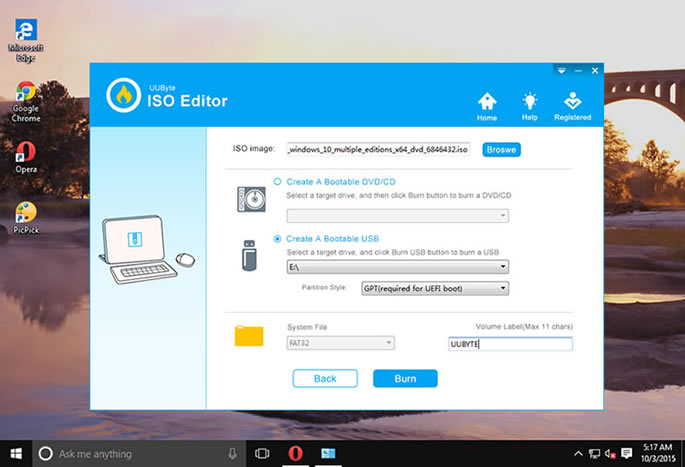
You have now formatted the partition of USB drive. It's time to download TransMac for Windows. Although this is a premium software, you can use the initial free trial period to create a bootable macOS USB drive on Windows 10. After installing the application, follow the sequence of steps shown below:
Step 1: Right-click the icon and select Run as Administrator from the contextual menu. Choose Run when prompted.
Step 2: Insert your formatted USB drive, and you will be able to see it in the TransMac software on the left panel.
Step 3: Right-click the USB and select Restore with Disk Image in the contextual menu. Click Yes in the warning popup.

Step 4: You will see a window that says Restore Disk Image to Drive. Here, select your DMG file in the dropdown menu and click OK.
Depending on the system configuration, this can take anywhere from a few minutes to a couple of hours. Once the progress bar is at 100%, a bootable USB is ready.
Part 4: Boot macOS Install USB on Mac
Now remove the USB drive and insert it into the Mac computer. To boot from the disk, you need to hold down the option key when you hear the boot chime. This will take you to the Startup Disk Manager, where you should be able to see the USB drive. It might have a different name, but as long as it is bootable, you'll be able to see it there. Once you select it, the computer will boot from the disk and the macOS installation will begin.
Conclusion:
Os X Create Dmg From App Download
The whole process might look a bit complicated if this is your first time, but just follow the instructions in this article and you should be fine. That being said, you need to be careful when downloading the DMG file and formatting your USB drive. If you don't do these two steps correctly, the output drive from the TransMac software won't be bootable, which means you can't install macOS using it, and you may need to do the whole thing over again.
On Monday Apple finally unveiled to the world the next iteration of OS X, Mavericks. A developer preview of the new operating system is available now as a Mac App Store download for registered developers. Delivering Mavericks via a download is super conveient and easy for everyday users but can be unhelpful in several troubleshooting or advanced OS modification situations. The only way to obtain a bootable OS X Mavericks USB flash drive is to create your own:
The Marek Bell blog notes that creating a bootable flash drive of Mavericks is a bit more intricate than Mountain Lion because “it is no longer possible to simply restore the InstallESD.dmg to get a bootable image for USB / Flash drive installation.” But there is a way around this obstacle, which Marek outlines in his thorough walkthrough of creating a bootable OS X Mavericks flash drive. You will need at least a 8GB Flash Drive (USB 3.0 is obviously a better choice).
- You are going to need to see some hidden files for this. So start by opening Terminal.app and pasting in the following (don’t worry, we’ll undo this change when we are done)…
defaults write com.apple.Finder AppleShowAllFiles YESkillall Finder - Download the installer as normal from the app store. (At time of writing this is only possible for those with access to the developer previews).
- After download you will have the ‘Install OS X 10.9′ app in your /Applications folder. Right-click it and select ‘Show Package Contents’.
- Navigate to the Contents/SharedSupport. There you will see the InstallESD.dmg file. Unfortunately, you can’t just grab it and restore it. Instead double-click it to mount it.
- You should now see the normally hidden BaseSystem.dmg file in the mounted volume.
- Open Disk Utility and restore the source BaseSystem.dmg to the destination of your USB drive.
- Now open up the restored USB volume (default name is OS X Base System) and navigate to System/Installation. In there you will see an alias for Packages. Delete this alias.
- Copy the full Packages folder from the root of the mounted InstallESD volume (the same place you got the BaseSystem.dmg file) to the USB volumes System/Installation folder. Basically, replace the Packages alias you just deleted with the real Packages folder from the original InstallESD volume.
- The USB drive should now be bootable. So simply restart, hold down the Option key (Alt) when booting with the USB drive in your machine, and you should get the option to boot from the USB drive.
- Remember, to rehide the normall hidden files just repeat step 1 but change YES to NO.
Os X Create Dmg From Apps
FTC: We use income earning auto affiliate links.More.