If you want to convert DMG to ISO, it's good to learn a little about disk image file types and what they're meant for. Essentially, a disk image is a snapshot of the content on a DVD, CD, BRD or even a hard drive. It could be just a set of media files, but it can also contain software installation files. In the second case, the disk image will also need to contain boot information in order to boot from the media.
Specifically, DMG is what Apple uses for the macOS environment, while ISO is more widely used in Windows-based and Linux environment. At times, you may need to convert DMG to ISO so you can mount it as a virtual drive on a Windows machine to extract the contents, view them or burn them to create bootable media. The process to convert DMG to ISO is different based on which operating system you're using for the conversion. This article shows you how to convert DMG files to ISO files on Windows, Mac and Linux.
Method 1: How to Convert DMG to ISO on Windows 10 (DMG2IMG)
- You are here: Tutorials Convert image file formats from command line You can run piso.exe to convert image file formats from command line or a batch file. The utility allows you convert image formats between ISO and other image formats.
- Mar 03, 2018 Choose the appropriate command line (in red) depending upon what OS X installer you want. Paste that entire command line from below at the Terminal's prompt: Command for macOS High Sierra. Question: Q: How to make El Capitan install.dmg file bootable More Less. Apple Footer.
DMG2IMG is a software utility that converts DMG files into Apple's older IMG format as well as the universally used ISO format. The process is simple, but it requires some command line work. The steps to use DMG2IMG to convert DMG to ISO have been detailed below:
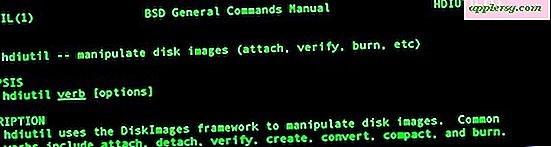
Mar 17, 2014 Disk Management From the Command-Line, Part 3 March 17, 2014 Disk imaging is a highly useful tool if you're wanting to create a whole copy of a volume and restore it back at a later date, either to the same disk or another one entirely. Dmg2img example.dmg example.iso. Where example.dmg is the source DMG file, and example.iso is the ISO file you want to create? As for the command line tool (dmg2img); I didn’t write that application, as indicated above, but the description is done in a very common way, as seen with most command line. Mar 28, 2007 If you have ever wanted to turn a DMG file into an ISO file, look no further than the handy command line utility called hdiutil, which is bundled in all versions of OS X. This can be helpful for many reasons, but one of the primary reasons to convert a DMG to ISO is for compatibility.
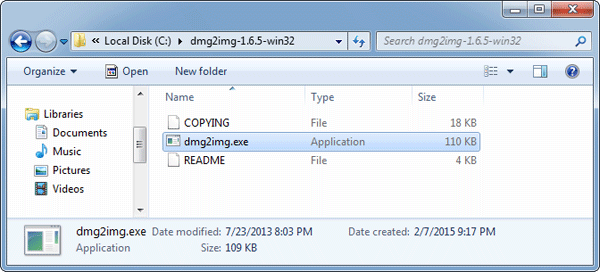
Step 1. Download and install DMG2IMG on your Windows computer. Once the installation is done, open File Explorer and go to the location where you downloaded the application.
Step 2. Right-click on the folder where the software has been downloaded, and select 'Open command window here…' to launch Command Prompt.
How to Quickly Create a Text File Using the Command Line in Linux. February 21, 2018, 11:23am EDT. If you’re a keyboard person, you can accomplish a lot of things just using the Linux command line. For example, there are a few easy-to-use methods for creating text files, should you need to do so. Create a Text File Using the Cat Command.
Step 3. In Command Prompt, execute the following command (click Enter after typing in the command):
dmg2img 'C:UsersSample UserDesktopsample.dmg' 'C:UsersSample UserDocumentsConvertedRandom.iso'
Step 4. Please note that the double-quotes are required only if you have a space in your file path. In this example, there's a space between Sample and User, so the quotes are needed. If there are no spaces, you can do away with the quotes.
This method only works in 32-bit Windows versions. The conversion is usually done accurately, but you may come across errors that can corrupt the output ISO file. If you're going to be doing a lot of such conversions from DMG to ISO, we recommend getting a proper software utility.
Method 2: How to Convert DMG to ISO on macOS (Disk Utility)
Mac OS X and macOS offer an easier way to convert DMG to ISO, which is only natural because DMG is the native disk image format used by Apple. The Disk Utility that's built into Mac will help you do the conversion from DMG to ISO. Follow the steps below to convert your disk image files:
Step 1. Launch Disk Utility in Mac from Applications > Utilities.
Step 2. Open a Finder window and double-click on the DMG file to mount it. You should be able to see it on the left panel in Disk Utility.
Step 3. Right-click the DMG file in the left panel and select 'Convert'. In the new window that appears, select 'DVD/CD Master' as your output and click on Save. This will save your DMG file in a format with the extension .cdr.
Step 4. Rename the file by replacing .cdr with .iso. The file is now in the ISO format.
Dmg File Mac
The exported ISO file can now be burned to a disk, or mounted within Mac as a virtual drive so you can view or extract the contents. The conversion process is quick, and it's convenient because it does not require any additional software.
Method 3: How to Convert DMG Files to ISO on Linux
In a Linux machine, you can use Terminal to convert DMG to ISO. For this, you will first need the Linux version of DMG2IMG. You can get it using a Terminal command, as shown below:
Step 1. Execute the following command in Terminal:
sudo apt-get update
sudo apt-get install dmg2img
Step 2. You can now proceed with the conversion command: dmg2img example.dmg example.iso
Step 3. You can also define a specific file path for the output (converted) file, but this basic command is what you need to use for the conversion.
As with any file conversion, the process to convert DMG to ISO could present some hurdles, such as corrupted files at output. If you see this happening multiple times, it's possible that the source file itself is corrupted. In such cases, it's better to try and get an authentic download rather than struggle with a corrupt file. In any case, if you're sure the DMG file is verified, these methods to convert DMG to ISO in Windows, macOS and Linux should work for you.
Related Articles & Tips
DMG files are proprietary disk image files used for software distribution in Mac OS. Providiing both password protection and bzip2-like compression, these files are perfect packaging medium.
Usually DMG files are opened automatically when you click them in Finder. They appear as a folder with files, but actually Finder mounts each DMG file as a separate filesystem and then shows you its contents. If you're observant enough, you'll see that in the left side panell of Finder you have all the active DMG filesystems listed and ready to be ejected once you finish copying the files or installing new software.
Sometimes you may want to download and mount DMG file using Mac OS command line, and in this post I'll show you how to do it
Why would you want to mount DMG files manually?
I've been business traveling quite a bit lately which means I'm most of the time away from my home computer. Naturally, I have configured Remote Desktop access so that I can use my iPad to access my desktop whenever I need, but sometimes it takes forever to do some simple things just because of the graphics environment overhead.
If you're like me, you'll probably find Remote Desktop over 3G to be pretty boring, and will want to do as much as you can via command line.
Mounting DMG with hdiutil command
In order to manually mount DMG file, you'll need to use hdiutil command. You don't have to be a privileged user, so can do it as your own user.
For this example, I'm going to use the command line interface (CLI) for the excellent HandBrake tool, which is great for converting all sorts of videos into iPad and iPhone friendly resolution and mp4 format
Let's mount the image from my dmg file:
As you can see from this output, the mount was successful and you now have the filesystem from DMG package available under the /Volumes/HandBrake-0.9.8-MacOSX.6_CLI_x86__64 directory.
Don't want to to take my word for it? Let's use the standard mount command to confirm that indeed we now have an new filesystem mounted:
Ejecting mounted DMG images from command line
How To Make A Dmg File From The Command Line Download
Once you are done with whatever you were trying to do, there's no longer a reason to keep your DMG image mounted, so you should unmount it. While it's possible to use umount command, I think it makes more sense if you use the same hdiutil tool that helped you mouunt the DMG image in the first place.
Dmg File Windows
Here's how you can eject the DMG image using hdiutil:
That's it for today, hope you liked the post! Let me know!